
Your Cooling Equipment Is Still Running. That Doesn’t Mean It’s Running Right.
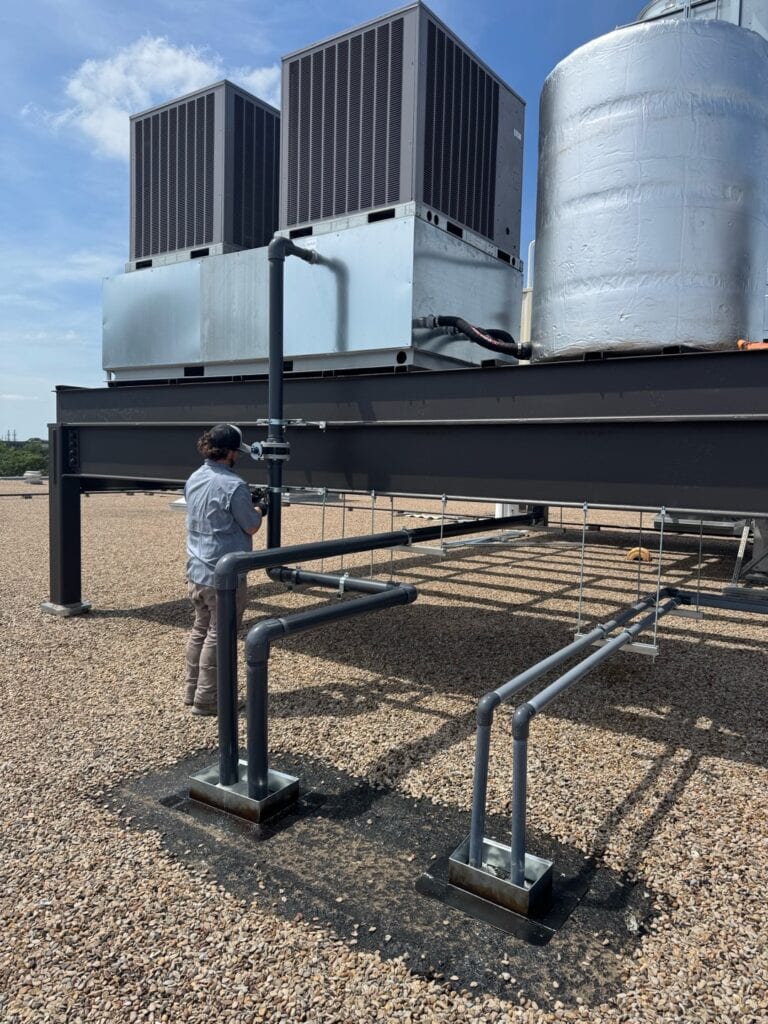
When you’re responsible for cooling across multiple facilities, you can’t stand in every mechanical room or on every roof. You’re managing tenants, ownership expectations, budgets, and a dozen competing priorities at once and your cooling equipment only earns your attention when something breaks. The units run, the buildings stay comfortable, and you move on to the next thing.
But “still running” and “running right” are two very different things and the gap between them shows up on your utility bills, and in surprise repair calls, long before it ever shows up as a shutdown. For a manager overseeing more than one site, that gap doesn’t add up. It multiplies.
The Biggest Cost You’re Not Watching
Across the properties you manage, cooling is almost always the largest energy user in the building. In facilities with a central plant, the chillers alone typically account for 30 to 50 percent of total electrical use. In buildings running rooftop units and condensing units, cooling is still the dominant load. Either way, it’s the biggest lever on your operating cost and the one that gets watched the least.
Here’s the part that surprises most managers: this equipment quietly loses efficiency without ever tripping an alarm. There’s no warning light for “you’re now spending 30 percent more than you should.” It just runs, and the overage lands on the bill. Across a portfolio of sites, that silent waste is real money leaving every building, every month.
The Same Problem Shows Up on Every Kind of Equipment
Whether it’s a central chiller plant, a bank of rooftop units (RTUs), condensing units (CUs), split systems, or the cooling towers feeding a plant, the failure mode is the same: heat transfer needs a clean surface and a healthy charge, and when it doesn’t get them, the equipment works harder to deliver the same cooling.
- Fouled coils and condensers. On a chiller, a scale layer just 0.3 mm thick can raise energy use by more than 12 percent, per ASHRAE data. On rooftop and condensing units, it’s worse: ASHRAE research shows dirty condenser coils can increase HVAC energy consumption by 27 to nearly 40 percent. On a single 30-ton commercial unit, that’s more than $2,200 a year in wasted electricity. Larger systems waste well over $4,000. Multiply that across every RTU on a campus and the number gets serious fast.
- Refrigerant and airflow problems. Low charge, restricted airflow, and worn components all force the system to run longer and draw more power for the same result.
- Condenser water drift and poor staging. On central plants, every 1°F of condenser water above design can cut efficiency 1 to 2 percent, and running chillers to full capacity one at a time spikes the peak demand charges that drive many commercial utility bills.
None of these trips a warning light. That’s exactly why they cost so much, and exactly why the cheapest bid often isn’t the cheapest outcome. A provider who diagnoses the actual problem the first time saves you the repeat visit, the repeat bill, and the emergency call at the worst possible moment.
What You Should Expect From the Vendor Managing It
You shouldn’t have to become an HVAC expert to know your equipment is being handled right. That’s the vendor’s job. Across your sites, that means:
- Someone who knows your equipment, not just cooling in general. Whether it’s Trane, Carrier, or York across your portfolio, the team servicing it should know the specifics of what you own.
- Dedicated, in-house technicians, not temporary labor rotating through. Consistency is what makes a vendor accountable and keeps someone familiar with the history of your buildings.
- Real reporting you can see. Through ServiceTitan, you get asset tracking, digital deficiency reports, and a documented service record so when ownership or your committee asks “why,” you have the picture in hand, not a verbal promise.
- Straight answers on cost. You should always know what’s wrong, what’s being done, and what it costs with itemized options, not just a 1-line estimate.
- Coverage when it matters. 24/7 emergency response with priority support for contracted clients, so a failure at one site doesn’t derail your whole week.
Best of all, most of this is recoverable value, not a rip-and-replace project. Clean coils, correct charge, and disciplined maintenance restore efficiency you’re already paying for. A fair price paying for itself, which is exactly the trade most managers want: not the lowest number, the right outcome.
One Less Thing to Worry About
The best cooling program is one you rarely have to think about, where problems get caught before they become surprises, where the numbers hold up when you take them to your boss, and where you can confidently point a sister property to the same team without putting your own credibility on the line.
At Reliable Plant Maintenance: a Class A licensed, fully insured HVAC-R contractor serving the DFW Metroplex since 2008 that’s the work we do every day. We don’t just know HVAC; we know your equipment. And we earn trust the same way we earn business: by getting it right.
Wondering what your cooling equipment is actually costing you at one site or across your whole portfolio? Reach out for an assessment, and let’s find the savings hiding in plain sight.
Sources
- Chiller plant share of building electrical use (30–50%) — Commercial Chiller Plant Optimization, OxMaint
- Dirty condenser coils raising HVAC energy use 27–40%; ~$2,200/yr per 30-ton unit; multiplies across a campus — W.B. Guimarin & Co. (citing ASHRAE)
- ASHRAE data on 0.3 mm scale raising chiller energy use >12% — EcoMax Global (citing ASHRAE Handbook)
- 1°F condenser water = 1–2% efficiency change — Maximizing Chiller Efficiency, ACHR News
- Chillers most efficient at 30–50% loading; peak demand implications — Setra, Are your chillers driving up your utility bill?
Need Service?
Contact the experts at Reliable Plant Maintenance.
Call us at 469-631-0571!